Posts

Showing posts with the label Linguistics

IC and PS Grammar - Linguistics Notes

Click here to download the notes in pdf format.

Transformation Rules (TG Grammar) - Linguistics

Click here to download the file in pdf format.
Image
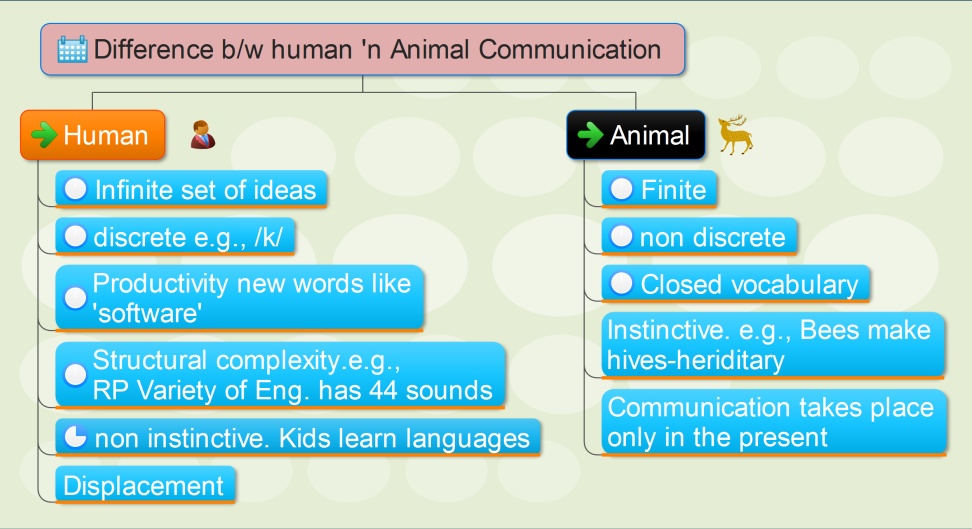
Language and Linguistics - differences between human and animal communication. Picture shows the differences between human and animal communication. 1.Discrete means humans sounds like /k/, /a/ have a rigid sound boundary whereas the animal's sounds like cows /maaa/, and crow's cawing has a set of sounds within them and it is very difficult to derive each sound from their sounds. A lion's roaring is much more complicated than this. 2.Displacement means we can talk about what we are going to do, may be we would go for a movie, to a park or any place we would like to. We can talk in the present, in the past and about the future. But animals' communication realm is limited only to the present, they do not have revenge that they wanted to fix, they do not have long lasting memory about their companions, they just live in the present, and they are happy in it. Characteristics of  Human Language This picture shows the characteristics of Human Language in a lin...

Language Varieties

List of Language varieties From Anjoe  I hope that this will help you in a sprint through the different language varieties a short. Get go... 1. Isoglose :i·so·gloss  (s-glôs, -gls) n. A geographic boundary line delimiting the area in which a given linguistic feature occurs. 2. Legalese :le·gal·ese  (lg-lz, -ls) n. The specialized vocabulary of the legal profession, especially when considered to be complex or abstruse. 3. Journalese :jour·nal·ese/ˌjərnlˈēz/ Noun: A hackneyed style of writing supposedly characteristic of newspapers and magazines 4. motherese [ˌmʌðəˈriːz] n (Linguistics) the simplified and repetitive type of speech, with exaggerated intonation and rhythm, often used by adults when speaking to babies 5. Literary Language   the language developed form of a national language, with norms fixed in writing to varying extents; the language of all manifestations of culture that are expressed in words. 6. Standard language :  A st...

Word Order in English

Word Order in English Look at these sentences; 1.He is going 2.Is he going In the above two sentences, simply by changing the order of the words in the sense or the meaning is altered. The first is the statement of fact. The second, on the other hand, demands an answer; in other words it is a question. This difference is brought about simply by change in word order. e.g., 1. çÉÞç Ï Þ øÞÎX §KæÜ? 2. øÞÎX çÉÞç Ï Þ §KæÜ? In these sentences inspite of the change in word order, there is absolutely no change in the meaning. This is because of the inflection 'çÉÞ ç Ï Þ ". The two basic word order in English are: 1.He is going (SV) 2.Is he going (VS) That is, the basic word order for statements is (SV) and the basic word order for questions is (VS). The extensions of the basic SV word order are: Subject-Verb-Object (SVO) Subject-Verb-Compliment (SVC) Subject-Verb-Adverbial (SVA) Subject-Verb-Direct Object-Indirect Object (SVOO) Subje...
Image
Grammatical features of Spoken & Written English; differences ·          Silent pauses. (by now-you-) ·          Repetitions (I, I am Mr…) ·          False starts (I knew he is , but some…) ·          Discourse markers (like, you see, I mean, you know…) ·          Short forms (I’m, I’d, they’ve…) 1)       In speech, tag questions are asked more frequently.            e.g., She is coming. Isn’t  she? 2)        Ellipses are very common in speech.     e.g., i)  Where to?                ii) Hope you are O.K.          ...
Image
Prescriptive Approach Prescriptive grammar usually tells people how language should and should not be used. That is, they ‘ Prescribe rules ’ of grammar and usage. (They take normative approach. norm=rule, normative=rule based.)     Comprehensive attempts at the standardization of English grammar began in the 18 th century. Many of the rules were taken from Latin and Greek grammar. This is because Latin and Greek were the classical languages all educated people knew; so these were regarded as models for English Grammar/other languages. But English is different from Latin or Greek and many rules were not suitable for English.    Thus the grammar of the times was based less on the actual usage of English by native speakers, than on borrowed rules.   This approach was conceived more about maintaining the purity of language and protecting it against corruption through changes. (But language is dynamic (have life) ; it cannot be made to stand still...